KEY TAKEAWAYS: The CanMNT kick off new cycle with gritty 1-0 win vs. Chile


The CanMNT have kicked off a new World Cup cycle on a victorious note, as they defeated Chile 1-0 at BMO Field on Saturday.
After a heartbreaking end to their 2026 World Cup journey, which saw them lose 3-0 to Morocco in the Round of 16 of that tournament, this Canadian team will be happy that they were able to deliver a win in their return to action, especially in front of their home fans.
With their performance this summer being seen as a resounding success, they’ll know that it’s imperative that they now build on what they’ve achieved over the last few years as they get set to tackle what’s still ahead of them.
At the same time, that’s not to say that this match was one that they’ll look back on quite fondly. Faced off against a physical Chile side, Canada struggled to build on a strong start despite a pair of Chile red cards that allowed Canada to play against nine players for over half an hour.
FINAL SCORE ⚽️
— OneSoccer (@onesoccer) September 27, 2026
Presented by BMO
The CanMNT 🇨🇦 defeat Chile 🇨🇱 1-0 at BMO Field in Toronto to kick off their homecoming tour & honour team legend Junior Hoilett in his final international match ✨ pic.twitter.com/lvl6LgS03a
Given what this Canadian team has shown to be capable of, not being able to secure a more comprehensive victory does stand out, as they were unable to find the ruthlessness one would’ve expected them to when seeing how the game played out.
Yet, that’s the double-edged nature of this Chile victory. On one hand, it serves as a reflection of how far this Canadian team has come; a comfortable victory against an opponent of this nature didn’t feel as satisfying as it should have - on the other hand, that’s just the sign of what life is like for ambitious international teams, as the expectations have shifted for them.
If Canada wants to achieve certain goals in this new cycle, which includes winning a trophy and improving on what they did this past summer at the 2030 World Cup, their performances will now be viewed through a different lens.
Therefore, in that context, this win felt far less satisfying. Even if that won’t matter to the various unproven players who got to earn significant opportunities in this game, or to longtime Canadian veteran Junior Hoilett, who earned a 15-minute cameo in his send-off game.
With that in mind, here are three KEY takeaways from this match.
The importance of a hot start:
 In a game where the bigger story was Canada’s inability to score against Chile’s nine players over the last forty minutes, it can be easy to forget how Canada started the game, as they came out with all sorts of positive energy.
To begin the match, they did a good job of pressing Chile, and had some excellent sequences on the ball, including the one that led to Jonathan David’s 12th-minute opening goal, which came off the sort of direct, attacking play that head coach Jesse Marsch will have been pleased to see from his side.
Of course, when seeing how Canada started the match, it makes it a bit puzzling that they weren’t able to maintain that as the game went on, however - even as they inserted all sorts of fresh legs into their team.
At the same time, to return to David’s goal, it’s worth noting how significant that was for this team, as this team has struggled to put the ball in the back of the net early in games as of late.
GOAL 🇨🇦
— OneSoccer (@onesoccer) September 26, 2026
WHO ELSE BUT JONATHAN DAVID? 😎
The CanMNT 🇨🇦 take a 1-0 lead over Chile 🇨🇱 courtesy of the Ice Man of Atlético Madrid 🥶 pic.twitter.com/eWQIxGTovW
During the World Cup, only two of Canada’s nine goals were scored in the first half, and those both came in Canada’s 6-0 drubbing of Qatar in group stage play. Otherwise, all of their other seven goals were scored in the second half, with five of them coming after the 75th minute.
And that’s not a new trend. In Canada’s four pre-tournament friendlies this year, only one of the five goals they scored came in the first half, showing that they’ve been struggling to score early goals all year long.
That’s no small detail, as that typically wasn’t much of a problem for them in the earlier part of Marsch’s tenure as head coach. As one would expect from a team that wants to play aggressively, Canada did a good job of putting teams on the ropes early, but would then struggle later in the game as their legs faded.
That shows why having a strong start was so important for them in this game. With their ongoing commitment to the identity Marsch wants them to have, starting games is going to be a big priority going forward, as this team is usually at their best when they can score an early goal and dictate how the game is played.
Too often at the World Cup, a lack of early goals meant playing games on other teams' terms, and that didn’t always lead to the best outcomes for Canada.
Otherwise, something else that stood out from Canada’s strong start? That Jonathan David was the one to find the back of the net, as that’s a goal that will do him a world of good.
After a mixed World Cup, where he was otherwise unable to make much of an impact other than the hat-trick he scored against Qatar (he failed to register a goal or an assist in any of the other games), pressure has been mounting on David to step up for Canada, especially after his tough season at Juventus.
With him back to his best following a loan move to Atlético Madrid, it’s nice to see him translate that form over to Canada with this goal - before that, he had only scored five goals in his previous 14 games for Canada, and that included the hat-trick against Qatar (the other two goals were a pair of penalties in a friendly against Iceland in March).
It feels like this Canadian team will only be at their best if they can get David firing regularly again, so it’s encouraging that he was able to find the net against Chile, even if it was far from the best goal he’s scored - they’ll now hope that’s a sign that he’ll be able to find some form and respond to the pressure that has been placed on him to perform for his country.
Canada’s ongoing struggles with low blocks:
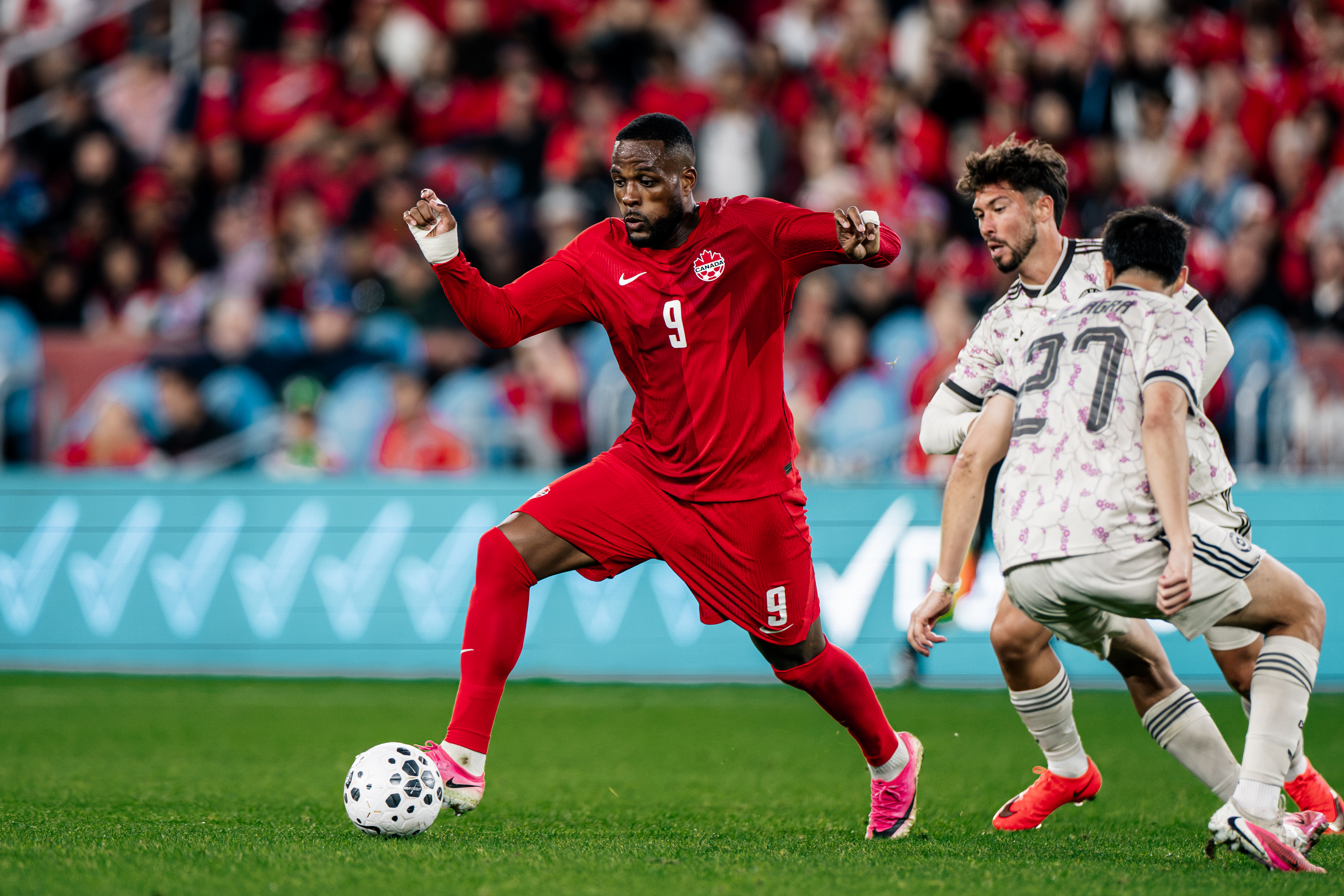 While Canada were able to get Jonathan David a goal, however, they were unable to get any of their other strikers to score, even despite the time they spent against a shorthanded Chile side, one that earned their pair of red cards on either side of half-time.
More worryingly, too, Canada showed signs of old struggles cropping up, as they struggled to create the sort of quality chances one would expect from a team that got to play 40 minutes against a shorthanded side.
In the first half, Canada managed to generate an impressive four big chances, further showing how strong they started the match - by comparison, in the second half, they generated no big chances despite taking 16 shots (they generated six shots in the first half, for context).
KEY TAKEAWAYS 🔑
— OneSoccer (@onesoccer) September 27, 2026
It's the start of a new cycle for the CanMNT 🇨🇦, and there's one very noticeable change in this team already: The cadence of crosses into the box ⏰
Here's what we noticed 👀 pic.twitter.com/ngZzYYH8nH
That’s a huge surprise, yet it explains what Canada did so well in their hot start, which was to generate quality attacking opportunities, and how they struggled to maintain that once Chile got the red cards and naturally retreated into a defensive shell.
Yet, this has been an issue for a while now with this Canadian team - they struggle to score goals in games where opponents sit back and invite them to attack in possession. Every once in a while, they’ll have an offensive outburst like the one they had against Qatar, or the 6-0 win they had at last summer’s Gold Cup opener against Honduras, but for the most part, low-scoring games have become far too common for this Canadian team.
Tajon Buchanan has gone 16 games without a goal or an assist for the #CanMNT 👀
— OneSoccer (@onesoccer) September 28, 2026
OS crew asks: Why has his club form not translated into Canada form? 🤔 pic.twitter.com/9zyhUxMmrF
It can’t be forgotten that Canada has now scored one goal or fewer in 15 of their last 24 games, and in 24 of their 37 total games under Jesse Marsch, showing how much of an issue it has remained for them since he’s taken over.
With that context, it also shows why the second half of this Chile game will have been frustrating for Canadian fans, as a lot of familiar issues cropped up. It’s not as if Canada tried something new but still earned familiar results - instead, they did a lot of the things that have led to their struggles, which naturally led to what felt like a predictable outcome.
Marsch did experiment with some new names and partnerships in the second half, as he took Jonathan David off for the last half hour, but tactically, it was a lot of the same for Canada offensively, which was surprising to see.
Could this have been a game to explore the 3-5-2 formation Marsch famously used in the second half of a pre-World Cup friendly against Uzbekistan, one that helped Canada find a 2-0 win? Or to try some other variation of a new attacking formation? 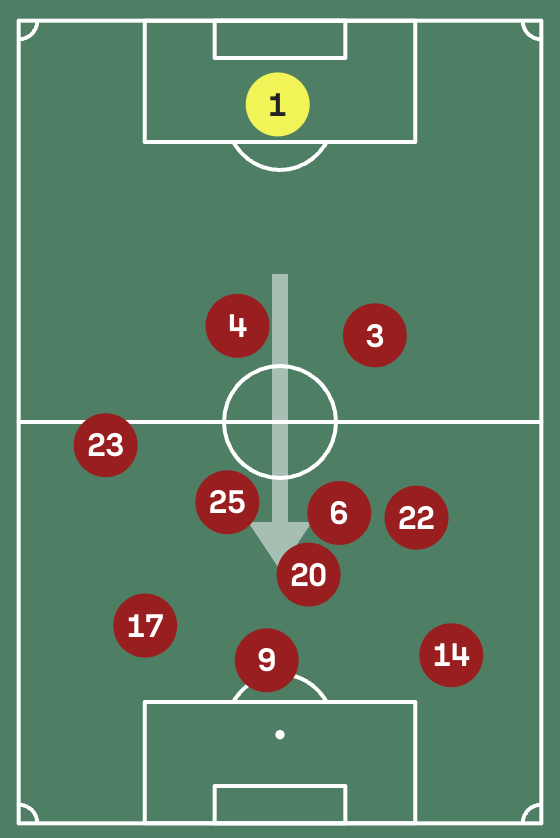
Here's Canada's average attacking positions from this game, as they mostly stuck in their 4-2-2-2, morphing into a 3-2-2-3 of sorts on the ball (SofaScore)
At the end of the day, these are the exact sort of matches where it would make sense to tinker with those sorts of tweaks, with these being friendly matches. Unlike some other international teams, who have had to dive straight into competitive matches this window, Canada has the luxury to play these games where they can be a bit more experimental.
Instead, they stuck with what they’re familiar with, and while that’s not a bad thing - again, they were able to carve out a relatively comfortable victory against an opponent they might’ve struggled to beat in past years - it also meant that some familiar issues cropped up for them.
Plus, it can’t be forgotten that the attack was just the more noticeable issue that cropped up - Canada did leak a few more chances than they should’ve defensively, especially while up two players, as some old issues also cropped up that side of their game.
All things for Marsch to ponder, no doubt, as he balances the challenge between integrating new faces into a familiar system, and tweaking that system to optimize certain factors. In this game, he prioritized the former, but he might have to place a bit more emphasis on the latter, especially heading into their game against Peru, who will gladly sit back and make life tough for this Canadian team off the ball.
New faces earn significant cameos:
 Speaking of new faces, however, that’s another big positive that came out of this game, as Marsch was able to give cameos to some players who are looking to integrate their way into this team long-term.
To start the match, Marsch decided to give centre back Ralph Priso, who could’ve very well made Canada’s World Cup squad if not for a run of untimely injuries, the chance to start the match - he played over an hour at centre back alongside Luc De Fougerolles.
Then, as the match went on, Jovan Ivanisevic and Richard Chukwu got to make their debuts off the bench, while Jamie Knight-Lebel and Jacen Russell-Rowe, who both have single-digit caps for Canada, also made cameos.
Among that group, all showed positive things, which is exactly what you want to see. Priso had some good moments on the ball, including a nice pass that helped create Canada’s goal (making up for a first-half error he made), while Ivanisevic did well to get stuck in and acquit himself with a physical Chilean team. Otherwise, Chukwu and Knight-Lebel didn’t get much time to show anything (although Chukwu had a nice pass near the end of the game), while Russell-Rowe had some bright moments in the attack.
That’s key, because while it might not seem like much right now, these sort of cameos can only help this Canadian team in the future.
As they begin this next cycle, Marsch must continue to expand this team’s depth and give opportunities to young players who can come into this group and compete for minutes going forward.
Among this group of youngsters, some players can absolutely make this team better over the next few years, so it’s good to see them get embedded into the fold now. Of course, some are more ready for these opportunities than others - Priso, for example, could be a candidate to start games this fall in the Nations League, as is Russell-Rowe, whereas Ivanisevic, Chukwu and Knight-Lebel seem to be more players for the future, but that’s only natural given where those respective players are at in their careers.
Now, it’ll be interesting to see how these youngsters build on this game, as they battle to earn more opportunities in this camp and going forward.
Will we see more of them against Peru, perhaps in starting opportunities? How about Daniel Jebbison, who was an unused substitute, and goalkeeper Owen Goodman, who will want to battle for a start? And now there’s Justin Smith, who was added to the group to replace Derek Cornelius and Jeevan Badwal, giving Marsch another option.
Certainly, fans wouldn’t complain if these youngsters are given more of a chance to shine, as this is exactly the camp for that - and to Marsch’s credit, he’s done a good job of providing them a platform to do that.