KEY TAKEAWAYS: What you NEED to know about CanMNT's 2026 World Cup squad

32 has now become 26.
After months of debate, discussion and auditions, the CanMNT have finalized their World Cup squad, as they named which 26 players will represent the country this summer.
Here is your CanMNT 🇨🇦 squad for the 2026 World Cup:
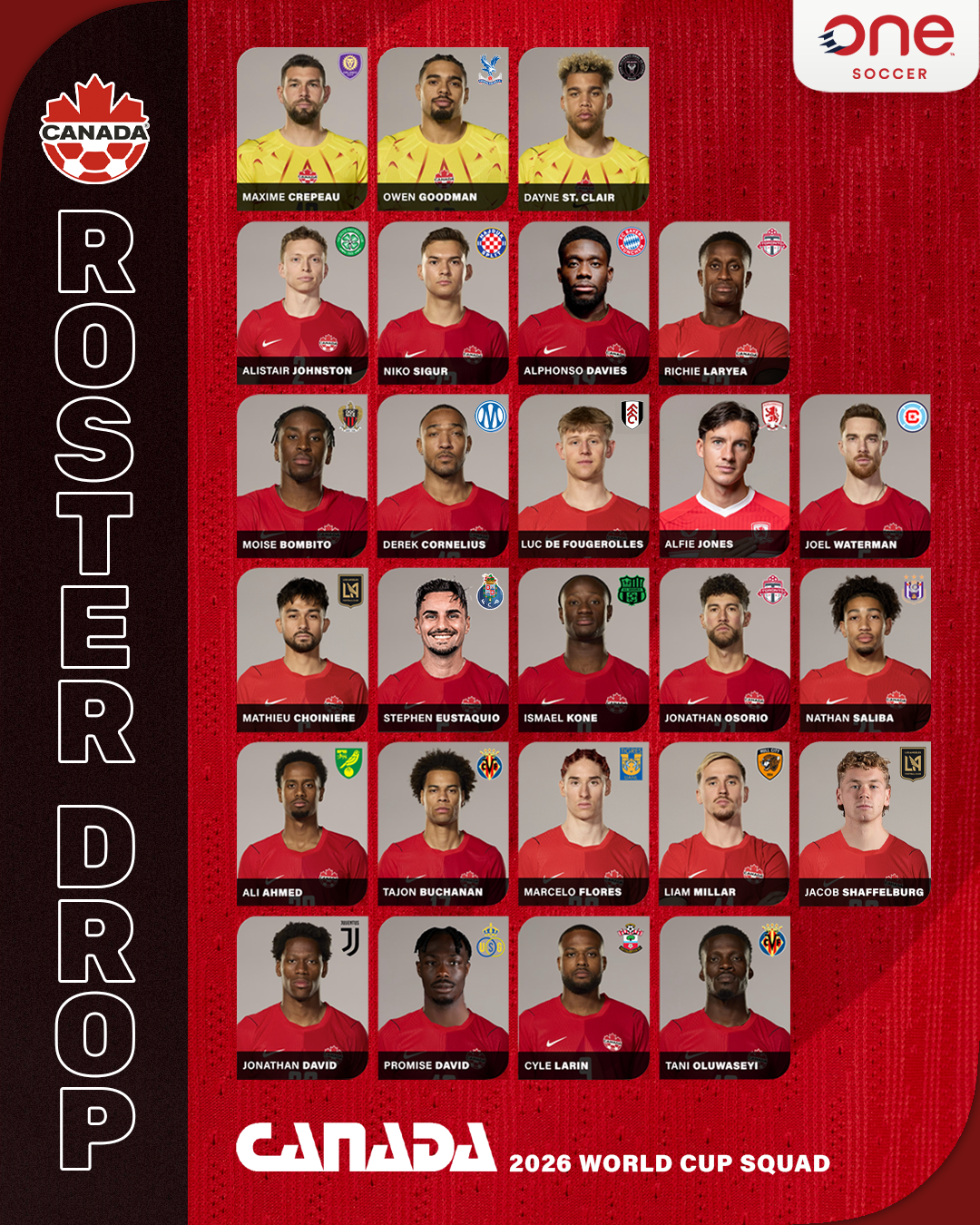
UPDATE: Since this squad was revealed, Marcelo Flores has been ruled out of the tournament with a knee injury sustained in the Concacaf Champions Cup final on May 30th.
It wasn’t an easy decision to make, as it came down to the wire for several players, but in the end, head coach Jesse Marsch and his staff were able to figure out which of the 26 players they felt would be best suited to play for Canada in this tournament.
Now, they’ll turn their focus towards ensuring that those 26 players are as ready as possible to hit the ground running in their World Cup opener on June 12th against Bosnia & Herzegovina. In the end, they knew that this roster selection was going to be extremely difficult - no matter which 26 players they picked, they knew they were going to leave some good players behind.
Such is the trade-off with the growth of this program in recent years, as it could’ve been argued that players left behind from this team, such as Ralph Priso, Kamal Miller, Zorhan Bassong, Daniel Jebbison, Jacen Russell-Rowe, Junior Hoilett and Jayden Nelson, would’ve all been good enough to crack Canada’s 2022 World Cup squad quite comfortably - in fact, it’s telling that Miller and Hoilett, who were on that 2022 group, weren’t able to make this team this time around, which more comes down to the improvement of the player pool than anything they did wrong.
Yet, this shows why a day like this is always bittersweet. While it’s important to celebrate the reveal of this squad, especially given how good and strong it is, you can’t help but feel for those who came so close to making it.
For what it’s worth, it’s not the end of the road for some of these players. A trio of them, Priso, Nelson and Bassong, will continue training with the group for now, with the possibility of still cracking the team if anyone suffers an injury between now and the tournament opener (something that ended up happening within 24 hours of the squad reveal to continue Canada's horrid luck wuth injuries).
In the meantime, though, the focus will stay squarely on the work that those who have made this team (for now), along with the staff, have to do ahead of June 12th, with a pair of pre-tournament friendlies on the docket next week.
Before looking too far ahead, however, here’s what stood out from the squad release.
The injuries didn’t have as much of an impact as thought… at least not yet:
Heading into the World Cup, the big story around this Canadian team remains their ongoing injury situation, as several players enter this tournament recovering from various physical ailments.
Yet, while it seemed possible that those injuries might rule some players out of contention, they look to have had minimal impact on the selection of this final squad.
Despite everything, Moïse Bombito, Alfie Jones, Luc De Fougerolles, Alphonso Davies, Richie Laryea, Ali Ahmed, Jacob Shaffelburg and Promise David are all included in this squad, which is excellent news.
On paper, it makes this a very strong Canadian squad, one that can be argued to be close to the strongest that Marsch has available to him, especially when considering the players #1 to #20 on this squad (you can always have debates about those on the fringes, no matter who is available or unavailable).
At the same time, it’s worth noting that while Marsch has called up a strong squad, one seemingly unaffected by injuries, the decisions he made still allow him to be flexible, so it’s not as if the inclusion of all these players means they’re all clear on the injury front.
Given that teams are allowed to replace any of the players in their squad up until 24 hours before their opening game (and goalkeepers at any point through the tournament if there’s an injury there), Canada still could make some tweaks to their squad over the next few weeks.
Because of that, it makes a lot of sense for Marsch to feel what his strongest available squad is and then prepare to make any changes if it turns out that any of his players not yet at 100% truly aren’t ready to go in time for June 12th - or if any surprise injuries crop up over that span.
What this shows, if anything, is that there is no player truly too hurt to miss out quite yet, which is positive. That’s key for players like Promise David and Alfie Jones, in particular, whose injuries seemed serious enough to potentially keep them out of this tournament - it’s worth noting that the rest of the players on that list are dealing with shorter-term injuries (like De Fougerolles, Laryea, Ahmed, Shaffelburg and Davies), or were on schedule to return for the World Cup despite longer-term injuries (like Bombito).
Now, though, seeing that Marsch has chosen to keep the trio of Bassong, Priso and Nelson around just in case of injuries, that does show that Canada has a ready-made contingency plan at hand if needed - and those selections help give an idea of what they’re keeping a close eye on when it comes to the health of their players.
With Bassong, it’s clear that Canada is still keeping the door open for him in case Davies or Laryea suffer any setbacks, as he’s the next player up at full-back, while with Priso, he’s there as insurance if centre-backs Jones, De Fougerolles or Bombito suffer any setbacks. Then, with Nelson, he’s there as a fallback plan for another winger in Shaffelburg, who didn’t train much over the last week.
Ideally, Marsch will be hoping he doesn’t have to call any of that reserve trio in, as it’ll have meant that his side made it through the next two weeks unscathed, but as we know, there’s no such guarantee that happens - especially given Canada’s injury luck over the past 18 months (and those words unfortunately proved to be prophetic). 
Attacking flexibility on the cards with positional selections:
To look at the actual composition of the squad itself, it’s interesting to see the breakdown of positions, as Marsch ended up selecting five centre-backs, four full-backs, five central midfielders, five wingers and four strikers.
For the most part, there isn’t too much that stands out from that - given Canada’s injury woes at centre back, Marsch was always likely to bring five players there, while Niko Sigur’s emergence as a capable full-back option was always going to allow Canada to be a bit lighter in midfield, given his ability to also play centrally.
As a result, it felt like the big thing to watch out for this camp was whether or not Marsch chose to bring an extra winger or striker, provided that he didn’t need to bring a sixth centre back or fifth full back because of his injury troubles there.
Turns out, his choice was to bring an extra winger, and that’s very interesting. Why, one might ask? Given that Marsch has typically chosen to bring an extra forward to camps whenever possible, it suggests that he might be looking to shake things up in attack.
With Canada’s continued use of their preferred 4-2-2-2 formation, it would’ve made more sense to bring five strikers instead of five wingers, at least when presuming that Marsch was going to continue to use natural strikers in those front two positions.
By initially bringing five wingers, however, that suggests that Canada wants to have a bit more flexibility offensively, thanks to the profile of one of those wingers, in particular - Marcelo Flores. With Flores’s ability to play as a #10, many wondered if Marsch might consider trying to play Flores underneath a striker in a 4-2-3-1, giving Canada another look offensively if needed.
Clearly, Marsch has more than considered this possibility, which helps explain the breakdown of strikers and wingers he’s selected in this squad - especially when you split it into three groups, which are out and out strikers, out and out wingers, and #10s. Among this attacking group, there are four out-and-out strikers, four out-and-out wingers, and then Flores - which makes the split of nine attackers that Marsch selected a bit clearer.
Now, though, it shows the challenge that Marsch faces with replacing Flores - does he consider trying to bring in someone with a similar profile, such as Jeevan Badwal and Junior Hoilett (who can both play as #10s and as wingers), or does he just bring someone in and throw out the experimentation he looked set to do? How he replaces Flores will show how committed he is to playing around with Canada's attacking set-up.
Because of that, keep an eye on Marsch's attacking selections and whether or not Flores's injury halts his potential plans to still try out a 4-2-3-1.
If he still commits to and succeeds with any offensive experimentation with a 4-2-3-1, either with Flores's replacement or someone else within the squad, it could open the door for a few other new ideas to emerge, such as the possibility of deploying midfielders Ismaël Koné and Jonathan Osorio in that #10 position, just to name one.
As a sidenote, that’s worth noting about this squad, by the way - Canada actually has a surprising amount of flexibility in other positions, too. Several players can fill in as full-backs and wingers, and they’ve got a few centre-backs who can step into midfield, so they don’t just have the flexibility to experiment in attack, either.
But given how good they’ve been defensively as of late, and the struggles they’ve had in the attack, it’s likelier that they try to shake things up front instead of messing with what’s worked for them at the other end, which is why it’s so noteworthy that they chose an extra winger over an extra forward. Especially considering that to do so, they left two good options at home in strikers Daniel Jebbison and Jacen Russell-Rowe, although that duo very much comes back into the picture after Flores's injury.
Focus shifts to lineup auditions:
Of course, now that the squad is mostly finalized, the big focus for Marsch and his staff will be to figure out some final battles when it comes to selecting his starting XI and preferred substitutes.
For example, when looking at that Bosnia game, you can already see that there are a few positions up for grabs.
Firstly, there’s the biggest positional battle of all, which is the #1 goalkeeper role, one that Marsch seemingly isn’t any closer to deciding - figuring that out sooner rather than later seems wise to avoid chatter about that getting too loud.
Then, at the back, everything remains up in the air. Had everyone been fully healthy, it’d feel safe to say that Alistair Johnston, Moïse Bombito, Derek Cornelius and Alphonso Davies would be the starting back four for that opening game, marking the return of Canada’s 2024 Copa América backline.
But with Davies unlikely to be available for the Bosnia match, and the fitness of Bombito and Cornelius still in question, there could still be some surprises to come from Marsch.
For what it’s worth, Bombito and Cornelius are trending to be ready to start, but both will need to show in the friendlies that they’re fit enough to go, or else Luc De Fougerolles or Joel Waterman could slot in (or Alfie Jones if his return to full fitness proceeds rapidly).
Otherwise, though, that leaves the lone battle at the back as the one between Richie Laryea and Niko Sigur to replace Davies. If fully healthy, Laryea will win that battle, but if there are any doubts about his status, Marsch won’t have any hesitation to turn to Sigur given how consistent he’s been since making his debut in the fall of 2024.
Moving up the field, there isn’t much debate about the starting midfield duo of Stephen Eustáquio and Ismaël Koné, as Nathan Saliba is only finding his way in if Marsch surprises and opts to use a formation with a third central midfielder, while Tajon Buchanan is a lock to start on the right.
On the left, however, a recent injury to Ali Ahmed has opened up a debate on whether or not he or Liam Millar will start ahead of him. If fully healthy in time, you have to think Ahmed starts, given how seamlessly he’s fit into Marsch’s system, but with how good Millar’s been lately, there will be zero hesitation in starting him if Ahmed’s not at 100% yet.
Lastly, that leaves up front, where the eternal debate remains on who to deploy alongside Jonathan David, who is a lock to start.
Right now, Cyle Larin is the favourite after his excellent end to the 2025-2026 season, but the pressure will be on him to replicate that form given his struggles for Canada over the past few years. Because if not, Marsch will have options to turn to, as Tani Oluwaseyi fits Canada’s system quite nicely even if his club form has dipped and he’s struggled to score for country, while Promise David is a nice wildcard who always has goals in him even if he doesn’t fit Canada’s system as well as the others. And that’s without considering that Marsch could consider playing someone as a true #10 underneath Jonathan David, should his aforementioned experimentation in the friendlies pay off.
Then, from there, Marsch will have plenty of fun when it comes to picking his preferred substitutes, which, to be fair, will depend entirely on what he does with the starting XI - so all of that to say is that he still has a lot to figure out over these next two weeks when it comes to deploying the players within this squad that he’s now selected here. 
Some roster release fun facts:
(These facts are based on Marcelo Flores's inclusion, with the CanMNT yet to name his replacement as of the most recent version of this article)
Interestingly, 13 players in this squad represented the CanMNT in Qatar, in Dayne St. Clair, Derek Cornelius, Joel Waterman, Alphonso Davies, Alistair Johnston, Richie Laryea, Stephen Eustáquio, Ismaël Koné, Jonathan Osorio, Tajon Buchanan, Liam Millar, Jonathan David and Cyle Larin. Of that group, three of them (St. Clair, Cornelius and Waterman) didn’t feature in a single game, while eight of them started games (Davies, Johnston, Laryea, Eustáquio, Osorio, Buchanan, David and Larin).
That means that 13 players in this squad are heading into their first World Cup - along with the three who didn’t feature in the last tournament, that means up to 16 players could make their tournament debut this summer.
20 players who were in this World Cup squad were in Canada’s squad for the 2024 Copa América, which was Marsch’s first tournament in charge, showing that Canada has a lot of familiarity within this group over the last two years.
3 players are heading to their first tournament with Canada in Alfie Jones, Owen Goodman and Marcelo Flores, who are all dual nationals who committed to the program within the last year. Otherwise, all of the other 23 players have featured in a World Cup, Copa América or Gold Cup squad for Canada.
Flores, of course, was in Mexico’s squad at the 2024 Copa América, so this isn’t his first international tournament, however.
In terms of leagues represented, 8 come from MLS, 4 from the EFL Championship, 3 from the Jupiler Pro League, 2 from La Liga, 2 from Serie A, 2 from the Scottish Premiership, 1 from the Bundesliga, 1 from Ligue 1, 1 from Liga MX, 1 from the Croatian Football League and 1 from EFL League One.
The most represented club is LAFC with three players, followed by Villarreal CF and Toronto FC with two apiece.
6 players have played with the Vancouver Whitecaps, 6 have played for CF Montréal, and 3 have or still play for Toronto FC (this includes players who have gone through the academy, but not featured for their first teams like Sigur with the Whitecaps).
Joel Waterman is the lone former Canadian Premier League player in the squad, having played for Cavalry FC in 2019.