Can the CanMNT actually beat Morocco? Here are 4 things they'll need to do to give themselves a chance


Could they actually pull it off?
That’s the question many Canadian soccer fans will be asking themselves ahead of this weekend, with the CanMNT set to take on Morocco in a tectonic Round of 16 clash at the World Cup on Saturday in Houston.
On paper, it promises to be a very tough matchup. There’s a reason why Morocco made a deep run at the last World Cup, as they’re an incredibly skilled and balanced side, one that excels in all phases of the game.
They’ve certainly shown that in this tournament, with an opening-game draw against heavyweights Brazil and a Round of 32 penalty shootout win vs. the Netherlands sitting as two examples of results that demonstrate Morocco’s development into an elite side in recent years.
Based on what they showed in those matches, there’s absolutely no reason why Morocco shouldn’t believe that they’re capable of winning the World Cup, becoming the first African team to do so.
Therefore, heading into a clash against a Canadian side that has never been on this stage before, you have to imagine that Morocco will feel confident about their chances of winning, as they look to continue their strong run through this tournament.
That, however, helps show why this Canadian side, who have reached the Round of 16 at a men’s World Cup for the first time after beating South Africa 1-0 in the Round of 32, face such a tough mountain to climb in this game.
CanMNT 🇨🇦 head coach Jesse Marsch on preparing for Morocco in the World Cup Round of 16 🎙️
— OneSoccer (@onesoccer) July 1, 2026
"I called preparing for Switzerland a horror show, but preparing for Morocco is like a gory, horrible nightmare. I don't want to watch them play – they're too good!
"Everyone's gonna… pic.twitter.com/NeosBPEjzt
At the same time, that’s not a bad thing from a Canadian perspective. When looking at this matchup, they head in with nothing to lose, as few will give them a chance against this Moroccan side.
As we’ve seen time and time again in this sport, anyone has a chance of winning a game on their day, which is why those Canadians will continue to ask themselves that question of ‘why not us?’ At the end of the day, it’s often said that a team with nothing to lose can often be the most dangerous to face, and it certainly feels like this Canadian team enters this game with a lot more to gain than anything else.
With that in mind, it’s worth asking the question - if Canada is to somehow win this game, what will they need to do right to make such an upset possible?
Here are four tactical questions that Canada will look to answer ahead of this Morocco game, as they look to give themselves their best chance at slaying a top side, picking up what would undoubtedly be the best result in the history of this program.
Should Canada slow down or speed up the game?
One of the most impressive things about watching this Morocco side? The speed at which they play, as they’re capable of playing games at a remarkable tempo.
That Round of 32 clash against the Netherlands was a prime example of that, as it was played at the speed and intensity of a UEFA Champions League knockout clash - and that was quite noticeable to the naked eye, especially after having watched a much slower Canada vs. South Africa clash the day prior.
Jesse Marsch, Nathan Saliba preview CanMNT 🇨🇦 vs. Morocco 🎙
— OneSoccer (@onesoccer) July 1, 2026
"We've outrun every opponent – and knowing that Morocco put in 120 minutes? We can be fresher and fitter."
"They're a good ball-playing team so it's just about being ready and intelligent" pic.twitter.com/wGpiKKSlRY
Given how much harder it can be to play at that sort of pace in international soccer, with the lack of time that players have to work together compared to the club game, it was quite impressive to see.
For context, Morocco’s match tempo (which is a stat by WyScout that tracks the number of team passes per pure minute of ball possession) is at 18.31 this tournament - to get an idea of how that tracks to other teams, France is at 18.02, Spain is at 18.49, and Argentina is at 19.39, putting them among the elite teams (Canada, meanwhile, is at 17.02).
Because of that, Canada needs to be ready to play this game at an extremely high pace.
For what it’s worth, though, Canada should be capable of doing that. One of the hallmarks of head coach Jesse Marsch’s system is the intensity at which they play on both sides of the ball, as Marsch pushes this Canadian side to do a lot of running in all phases of play and to impose themselves on games.
Therefore, while we haven’t seen Canada play the fastest games this tournament, that’s been more due to the opponents that they’ve played - Bosnia & Herzegovina, Qatar and South Africa all tried to slow down the game against Canada, while against Switzerland, Canada had a bit of an off day and struggled to play with their usual pace until far too late in the game.
Typically, when faced off against top opponents like Morocco, Canada hasn’t had a problem in playing at the intensity required to compete in such a match - immediately, you can think of how they looked in a 0-0 draw against Colombia last fall as a game where Canada went up against a top side and didn’t look out of place.
Now, the bigger question is whether or not Canada should commit to playing the game at such a high pace against Morocco, as the challenge for them won’t be whether or not they can match it, but for how long they can sustain that level of effort instead.
Given that Morocco were able to maintain a high level of intensity for over 120 minutes against the Netherlands, it shows that they won’t have much problem when it comes to keeping the speed of the game high, which could be a worry for a Canadian team that has been known to fade in games in the past (although that hasn’t been much of a problem for them as of late).
With Canada struggling to start games fast this tournament, perhaps they’ll be more focused on how they start than how they finish, but it’s something that they’ll want to take note of regardless.
Ultimately, though, it feels like Canada’s best strategy will be to manage the game based on how things develop. If the game calls for it, they should have no shame in trying to slow down play and disrupt Morocco’s rhythm, instead of needing to play at 100 miles an hour for 90 minutes (or more) - but they also shouldn’t be shy in trying to match that pace when needed, either. It’ll be all about balance, at the end of the day. 
What are the threats to Canada’s backline?
When looking at this Morocco team, they’ve got a big three of players to watch out for, as the trio of Achraf Hakimi, Brahim Diaz and Ismael Saibari have been their main offensive threats in this tournament.
The raw numbers show that, as in four Morocco games, Saibari has three goals, Hakimi has a goal and an assist, and Diaz has two assists.
Plus, even beyond the counting numbers, you can see their impact when seeing how influential they are in the attacking phases of the game, too. In particular, Hakimi is the most fascinating one, as despite playing at right back, he’s taken 13 shots (worth 2.07 xG) and has generated 14 key passes (worth 0.93 xA) - for context, he’s created the second most chances of anyone in this World Cup (as of writing), showing that he’s not just been one of the best attacking defenders at this tournament, but one of the best attacking players, period (# via OPTA). 
Here's Hakimi's heatmap from this tournament, showing how involved he is in possession down the right side (SofaScore)
Yet, that’s due to Morocco’s tactical set-up, which elevates Hakimi’s strengths, and the pair of Diaz and Saibari do a great job of helping make that possible.
To begin, there’s the work that Diaz does, as he’s deployed as a right winger, but one that has the freedom to drift inside as a #10. He’s developed an excellent synergy with Hakimi, who gets to fly forward and fill space out wide, combining with Diaz in pockets and the half-spaces on the right side of the pitch.
Then, there’s the work done by Saibari, which has been quite impressive to see. Nominally more of a winger or a #10, he’s been deployed as a false nine this tournament, and he’s thrived in that new role.
Not only is he able to drop in and combine with his teammates, which drags defenders with him and opens up space behind the backline for Hakimi to run into, but he also does a good job of making the traditional striker runs that false nines don’t typically make, which also frees up space in between the lines for Diaz.
Yet, that shows why that trio is so key to how Morocco attacks, as they all complement each other quite nicely. There are other key pieces to watch on the ball, no doubt, such as Azzedine Ounahi, Bilal El Khannouss and Ayyoub Bouhaddi (with Bouhaddi, in particular, having an excellent tournament), but make no mistake - this team is built around the strengths of Hakimi, Diaz and Saibari.
From a Canadian perspective, what that means, however, is that they’ve got to be extra diligent with how they defend that right-hand side trident, which is going to be worth watching. 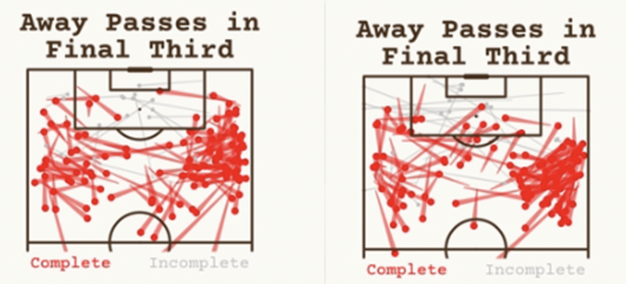
Here's Morocco's passes into the final third from their clashes vs. Brazil (left) and the Netherlands (right), showing how dangerous they are down the right side (via @BeGriffis on BlueSky)
Namely, the big thing that Canada needs to ensure that they do is to offer support to their left back, Richie Laryea, which in their 4-2-2-2 formation, will come from the left-centre back, left winger, and their left-sided central midfielder.
The good news is that at left wing, they’ve got the perfect player for that in Ali Ahmed, who is an extremely defensively responsible winger - after not starting against South Africa, you have to imagine he comes in as a starter this game to help Laryea.
As for the other positions, Canada will have to decide if they deploy Derek Cornelius, Moïse Bombito or Luc De Fougerolles at left centre back - and more specifically which of those two centre backs they start together, which will help them better answer that question (you have to imagine Bombito is the preferred option there). Then, in midfield, the players to watch are Nathan Saliba, Niko Sigur and Mathieu Choinière - on paper, given his ability to cover ground, Choinière could be an intriguing choice.
Of course, squad selection is just half the equation, as Canada will then have to actually make sure that they’re doing the defensive work required to hone in on Hakimi, Diaz and Saibari, but that’s a whole other challenge - and given that Canada has conceded just 2.4 xG in four games, that should hopefully be one that they’re up for. 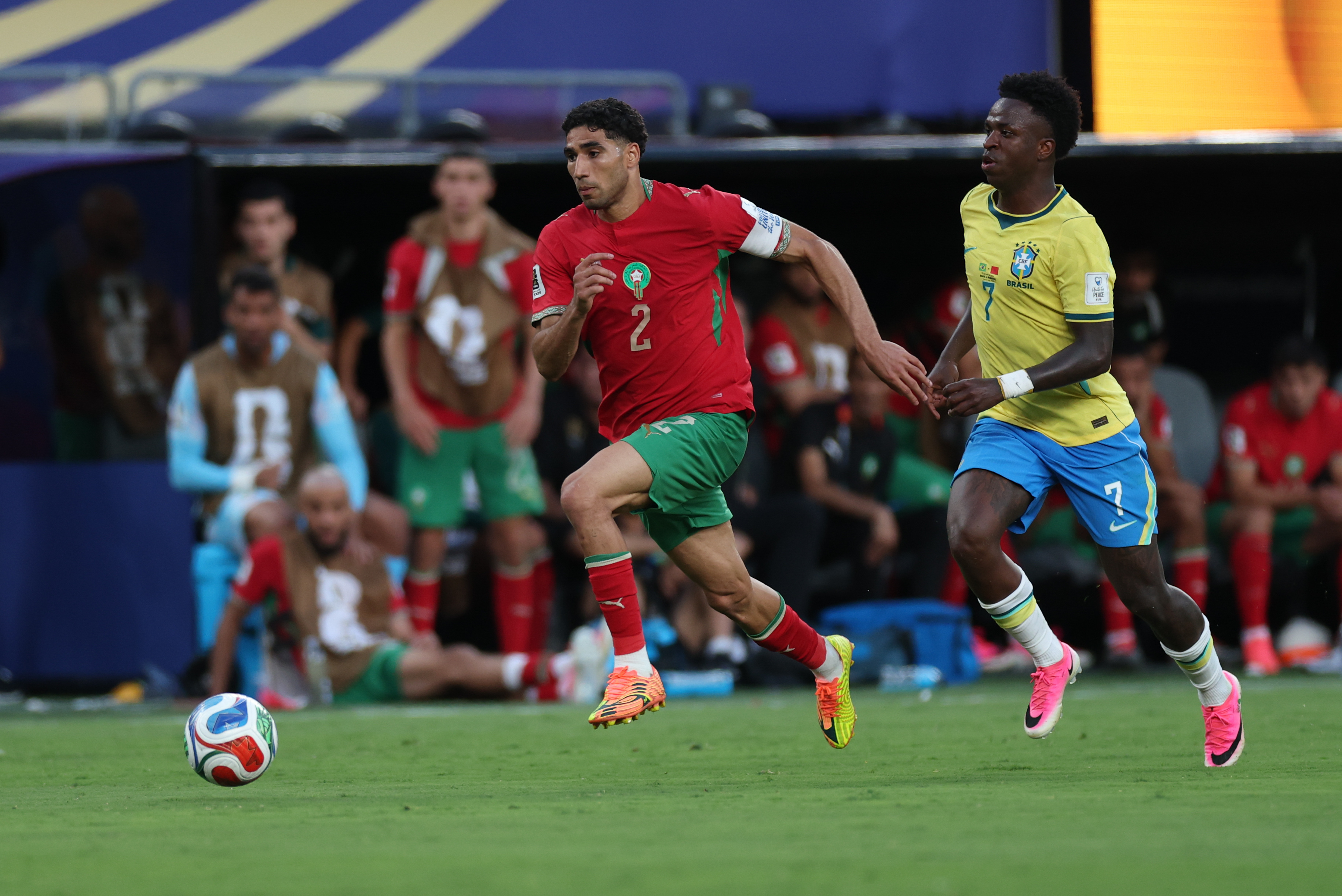
How to deploy the midfield?
To return to midfield, however, defending Hakimi, Diaz and Saibari is just one of the many responsibilities that Canada’s central players will have to deal with in this game. On the ball, they’ll have a lot of work to do to break down Morocco’s strong mid-block, while out of possession, they’ll have to be incredibly organized and diligent to help deal with Morocco’s threats between the lines, such as Diaz, Saibari, Ounahi, Bouhaddi and others.
Because of that, you can only wonder if Canada is tempted to deploy a third central midfielder, something they don’t typically do too often.
When seeing the way the Netherlands struggled in midfield, as they shockingly switched from a 4-3-3 to a 5-4-1 for their Round of 32 match, it’s a valid question to ask of Canada, who might be tempted to make an opposite switch from a double-pivot to a midfield trio.
There's been some chatter about the #CanMNT shifting to a back 5 vs. Morocco... any shot we actually see it happen? 👀
— OneSoccer (@onesoccer) July 2, 2026
"No, but I think you need to meet this challenge by bolstering the midfield instead" pic.twitter.com/hteIqDC1Pu
Of course, the easy way for Canada to do that would be to drop one of their two strikers in their 4-2-2-2 and to turn it into a 4-2-3-1, a formation Marsch has used in the past, especially when he was at Leeds United. With his pressing ability, Mathieu Choinière could fit nicely in that #10 role, who often presses like a second striker out of possession - otherwise, Jonathan Osorio could be an option there, too, although it’d be a surprise to see him start (meanwhile, Nathan Saliba and Niko Sigur would battle to start alongside Stephen Eustáquio in the double-pivot).
If Canada doesn’t want to switch from their 4-2-2-2, however, they do have another option to consider, and that’s to deploy one of their midfielders as a winger out of possession, something they did in a pre-World Cup friendly against Uzbekistan.
In the second half of that game, they deployed Osorio as a right-sided winger defensively, which allowed them to still defend in that 4-2-2-2, but in possession, he would drift inside and play as a #10, which allowed Canada to attack in a 3-5-2.
Could a scenario like that make sense in this game, where Canada will need to be a bit more robust centrally? If Canada chooses to go that route, Niko Sigur could be very well-suited to that role, as he’s played as a wide midfielder before - otherwise, you can wonder if Nathan Saliba could also benefit from the freedom of such a role, too, which could allow Canada to run with a more defensive double-pivot of Eustáquio and Choinière.
What that shows, though, is that while Canada will be unlikely to make any radical changes to their formation, they can still make tweaks to adjust to Morocco’s strengths, and one area where they might need to do that will be in midfield. 
Where will there be goals to be scored?
Of course, a lot of the talk so far has been centred around Morocco’s strengths, and rightfully so - if Canada is to have any chance of winning this game, they have to do everything in their power to limit what this Moroccan team does best.
At the same time, that doesn’t mean that Canada shouldn’t forget about Morocco’s weaknesses, either, as they’ll have to find a way to exploit them if they’re to further improve their odds of winning. After all, soccer is a sport where teams need to maximize their strengths and limit their weaknesses, so Canada must find a way to exploit areas where this Moroccan team struggles.
Of course, when you’re faced off against a team as good as Morocco, it can be a lot harder to find and then expose those weaknesses, but it’s not as if Morocco have been perfect to this stage.
Mainly, it stands out that they’ve conceded four goals in four games, which is quite solid, but a sign that they’re underperforming their defensive metrics - they’ve conceded those four goals despite giving up just 3.2 xG (OPTA).
Given that they’ve conceded just 7.25 shots per game (WyScout), they’ve not given up a lot of shot volume, so it shows that when they do give up chances, they’ve tended to be big ones, as they’ve been a bit leakier than typical (for context, they conceded just five goals in seven games during the 2022 World Cup).
Because of that, it shows that the big area where this Canadian team will hope to exploit Morocco will be in attack, especially in transition moments, as they look to prey on that vulnerability Morocco has shown there (which the Netherlands did well to do on their goal in the Round of 32).
WHAT A MOMENT FOR CODY GAKPO!
— TSN (@TSN_Sports) June 30, 2026
Gakpo scores the goal to take the lead for the Netherlands and is emotional as over the weekend it was announced he and his wife lost their baby during pregnancy.
A real special moment for Cody Gakpo. pic.twitter.com/OFy9F1E14H
When this Morocco team gets set in their defensive block, they’re incredibly hard to beat, but they can let things get a little wide-open in transition, which makes a lot of sense - with the way that they push Hakimi forward, and with how aggressive their midfielders are on the ball, their defensive rotations can be a little slower than most teams.
Therefore, it feels like Canada needs to make sure that they’re set up to do some damage in those counter-attacking moments, which is something they’re well suited to doing, in theory.
For example, you have to imagine this gives Tani Oluwaseyi a strong chance of starting up front, as he is Canada’s fastest and most direct striker (among Canada's 4 strikers, he's hit the fastest speed this World Cup at 35.8 km/h, and is averaging the most sprints per 90 minutes), while this could also push Canada to deploy wingers such as Jacob Shaffelburg and Jayden Nelson, whether that’s from the start or off the bench, to give them more speed in wide areas.
Then, this will also put pressure on the likes of Jonathan David and Tajon Buchanan, who are expected to start in this game if Marsch chooses to go for familiarity in his starting lineup, to be sharper and more decisive in those attacking transition moments, something both have struggled with for most of this tournament, but are capable of doing at their best.
Yet, overall, that ties into another theme that will prove to be quite crucial for Canada in this game - they’ve got to be a lot more clinical with their chances. They’ve already missed a whopping 11 big chances this tournament (OPTA), which is fourth (as of writing), something they can’t afford to do against a team as good as Morocco.
That’s something that this Canadian team is well aware of from past encounters against top sides, but it bears repeating ahead of such a crucial game, as the key to beating a big side isn’t just to play well - that’s the bare minimum requirement - but to make the most of your opportunities when they come around, too.
And for Canada, it looks like those opportunities are likely to be there in attacking transition moments, which is something that they’ll have to account for when setting up their team.