AGR: Centre back injury woes continue to pile up for the CanMNT after Alfie Jones' surgery



The injury woes have continued to pile up for CanMNT defenders to start 2026, as centre back Alfie Jones underwent surgery on his ankle this week.
Now, he is set for a spell of approximately two months on the sidelines, which puts him in a tight race to return for Canada’s next set of friendlies, which will be played between the 23rd and 31st of March - around 10 weeks from now.
Early word is that Canada centre back Alfie Jones will be out a couple months after surgery. His World Cup is not believed to be in jeopardy. #CANMNT (📸: Jones’ IG) pic.twitter.com/8n2pegEvOc
— Joshua Kloke (@joshuakloke) January 7, 2026
Given that Jones has participated in just one camp since committing to the program last fall, making his debut in a 2-0 win vs. Venezuela last November, he will certainly be hoping he can return ahead of that March camp, giving him the chance to add to his solitary international appearance before the start of the 2026 World Cup.
In the immediate future, though, he’ll have to watch Middlesbrough’s push for promotion to the Premier League from the sidelines, after having started all but one of his team’s games so far in the Championship in 2025-2026.
For Canadian head coach Jesse Marsch, that’s a big concern, as he was hoping to rely on Jones in a big way this year. With his two usual starting centre-backs, Moïse Bombito and Derek Cornelius, also currently sidelined with injuries, Jones’s arrival was seen as a huge boost, giving Canada much-needed depth to help overcome Bombito’s and Cornelius’s injury woes, especially if they were to drag on longer than anticipated.
🔵 "It's always an honour to play for your own country... as a club manager you always want to protect your players."
— Sky Sports Scotland (@ScotlandSky) November 21, 2025
Rangers head coach Danny Röhl says John Souttar, Mikey Moore and Derek Cornelius may be out for the rest of the year with injuries ⤵️ pic.twitter.com/3au8Ys7hF4
The good news for Canada is that, theoretically, Bombito and Cornelius should be healthy in time for the March window.
When Bombito fractured his tibia, a potential recovery timeline was set at around four months, which would see him return to action for OGC Nice sometime in February. Meanwhile, Cornelius had surgery to fix an unspecified muscle injury at the end of November, with Rangers manager Danny Röhl suggesting that he’ll be out until at least the end of January.
At the same time, even if both can return in time for March, it remains to be seen what shape they return in, as they’ll come back to action at a strange time. One of the difficulties of dealing with an extended absence in the middle of the season is that it can really take a player out of rhythm at a time when players tend to peak in a campaign - because of that, some players can struggle to find their feet when dropping back into a team’s squad in the second half of a campaign.
Moïse Bombito gives an update on his injury.#FIFAWorldCup pic.twitter.com/ALsE4DKbf0
— TSN (@TSN_Sports) December 5, 2025
To be fair, Cornelius at least got a good chunk of minutes under his belt before getting injured, playing 1000 minutes for Rangers before going down with his muscle issue - Bombito, meanwhile, played just 146 minutes for Nice in 2025-2026 before his injury, as he missed the start of the season with a stress fracture.
All of a sudden, it’s understandable to have concerns that Bombito might take more time to shake off the rust, which he’ll want to do by the time June rolls around, given that he’s Canada’s best centre back when healthy. 
Doubly so, too, when realizing Bombito only played 180 minutes for Canada in 2025 due to these injury woes, a far cry from the 1170 minutes he accumulated across 13 games in 2024, the pressure will be on him to step back into this team as quickly as possible.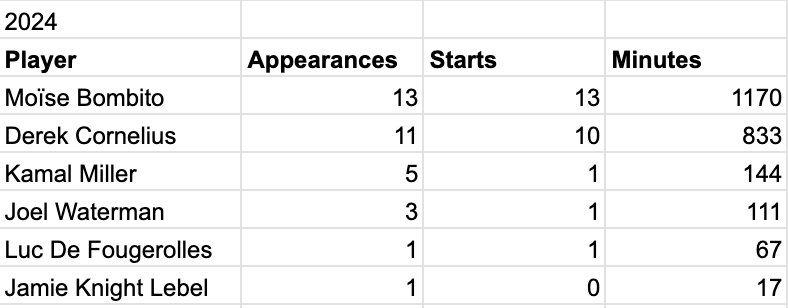
Here's a look at how many minutes that CanMNT centre backs accumulated in 2024. As seen here, Bombito led the way, closely followed by Cornelius, with most other players playing more of a depth role with Marsch leaning heavily on that Bombito and Cornelius pair (OPTA)
What that all shows, though, is why it’ll be imperative that Canada can rely upon Bombito, Cornelius and Jones by the time March rolls around, as they’ll want to ensure that all three can take the opportunity to build some chemistry together.
Of course, it’s worth noting that Canada’s centre back pool is arguably deeper than ever before, so it’s not as if the absence of any of those names will completely sink them, either. For example, after Bombito and Cornelius, the third-most used centre back under Marsch is actually the 20-year-old Luc De Fougerolles, who benefited significantly from Bombito’s 2025 injury woes, accumulating 610 minutes across nine appearances last year. 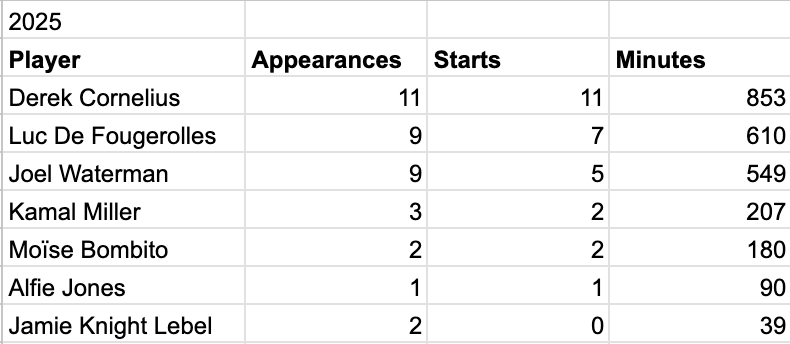
Here's how many minutes centre backs accumulated for the CanMNT in 2025 - as seen here, the allocation was a lot more mixed, with Bombito sitting as the fifth most used centre back. In particular, De Fougerolles and Waterman benefitted from his absence (OPTA)
Not only that, but he thrived across those minutes, too, showing that despite his age, he’s a lot closer to earning a starting role on this Canadian team than anyone previously thought, showing good aggression off the ball and good composure on it - thanks to that, he was even named Canada Soccer's CanMNT Young Player of the Year.
Luc De Fougerolles named Canada Soccer’s 2025 Young Player of the Year 🍁
— Canada Soccer (@CanadaSoccerEN) December 17, 2025
Although Luc De Fougerolles made his debut in 2024 at the Copa América, 2025 was his breakout year with Canada Soccer’s Men’s National Team. Following injuries to Moïse Bombito, De Fougerolles found… pic.twitter.com/JOKla4kncu
Ironically, it’s just Canada’s luck right now that De Fougerolles himself is just coming back from an injury of his own, as he suffered an abdominal injury that Marsch reported to be pubalgia, but he managed to make four appearances for his club FCV Dender before the Belgian league went on winter break - although just one of them was a start. After starting 13 games across all competitions before his injury, he’ll hope to pick up where he left off when Dender resumes play, which they’ll do with a Belgian Cup matchup against CanMNT teammate Promise David and Union St-Gilloise on January 14th, as De Fougerolles may have a big role to play for this Canadian side in 2026.
Plus, beyond De Fougerolles, Canada can also rely on MLS veterans Joel Waterman and Kamal Miller, too, who are more than capable options. There’s a reason why Waterman has now accumulated 660 minutes for Canada under Marsch, with Miller sitting at 351, as they’ve both proven that they can fill in where needed, even if they’re likely no higher than #5 and #6 on the depth chart when everyone is healthy. 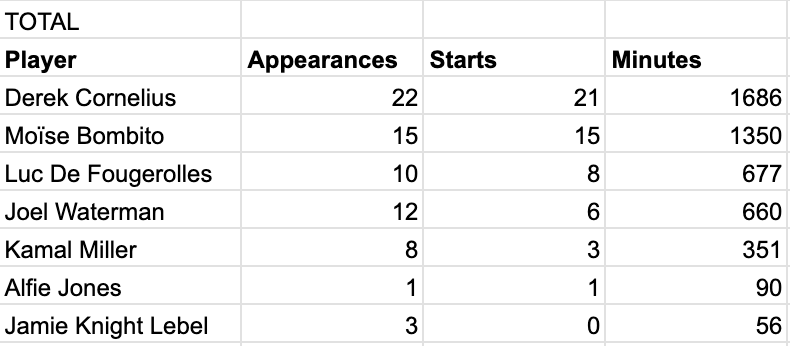
Here's how many minutes the CanMNT centre backs have racked up under Jesse Marsch, for context (OPTA)
On past Canadian teams, they’d probably be in contention to start games quite regularly, but with the emergence of Bombito, Cornelius, Jones and De Fougerolles, who all play at a good level in Europe, Waterman and Miller have fallen down the depth chart.
Then, if Canada needs to go even further beyond that, the emergence of someone like Ralph Priso as a centre back option after a breakout year with the Vancouver Whitecaps in MLS is another good story, showing that Marsch at least has other options to look at - and Priso is but one of a few other names who could potentially step up if needed after good years in MLS and even in Europe (such as Jamie Knight Lebel).
Yet, that does help explain that despite Canada’s injury woes in 2025, their defensive results didn’t suffer - in fact, they improved. After conceding an average of a goal against per game in 2024, they conceded just 0.57 goals against per game in 2025, as they allowed significantly fewer shots, touches in the box and xG against.
As a result, they were able to keep eight clean sheets in 14 games in 2025, after having kept a respectable six clean sheets in 13 games in 2024 under Marsch, which is no small feat given that they handed six different centre-backs starts in 2025.
If anything, Canada’s big priority in 2026 is figuring out how to score more goals, instead of preventing them, but that doesn’t mean they should completely forget about their defence, either. 
Ultimately, if they’re going to make a run at the World Cup, they’ll need to be able to keep goals out of their net, especially if they continue to struggle in front of goal, so there will be a lot of pressure on their defenders to maintain a certain level of play heading into that tournament.
Plus, at the World Cup, they’ll face a better level of competition than anything they’ve faced in recent years, even when considering that they’ve actually held their own defensively against some good teams in recent months. In the World Cup, everyone will bring their best, which isn’t always the case in friendlies - something that can sometimes be easy to forget when achieving good results in those matches.
What that all shows, though, is why Jones’s surgery this week, and the ongoing recoveries of Bombito, Cornelius and De Fougerolles, stand out as such big news for this Canadian team - especially when considering the other long-term injuries suffered by other Canadian defenders at other positions in 2025, such as Alphonso Davies and Alistair Johnston.
While Canada has struck a good balance as a team defensively so far under Marsch, they’ll want to ensure that they’re able to plug their best individuals into that system by the time the World Cup comes around - and they’ll then want to ensure that those individuals are then able to keep on thriving as they previously have in this system.
In a big tournament like that one, individual quality can often decide games, with the margin for error sitting a lot lower, so Canada will be hoping they’re not fielding a patchwork and out-of-form back four by the time next summer rolls around.
Canada saw the impact that defensive disorganization can have firsthand at the 2022 World Cup, as defensive mistakes ended up cratering what was otherwise not a bad overall performance from them as a team, something they’re hoping to correct this time around. (And on the flipside, strong defensive performances carried Canada deep into the 2024 Copa América).
Until the start of the World Cup, though, they’ll be following the ongoing recoveries of their defenders with a close eye, before hopefully taking advantage of the limited preparation time they’ve got left - even if they know they’re in a race against the clock due to all of these injuries. In the end, their backline could be the difference between a group stage exit and reaching a Round of 16, for example, so they’ll look to ensure that they’re bringing their best on June 12th and beyond.